 CommerceHero
Affiliate marketing · Partner operations
How to run a Shopify affiliate program without spreadsheet chaos
A practical operating model for onboarding partners, tracking attributed sales, reviewing commissions, and keeping payouts clear as your affiliate program grows.
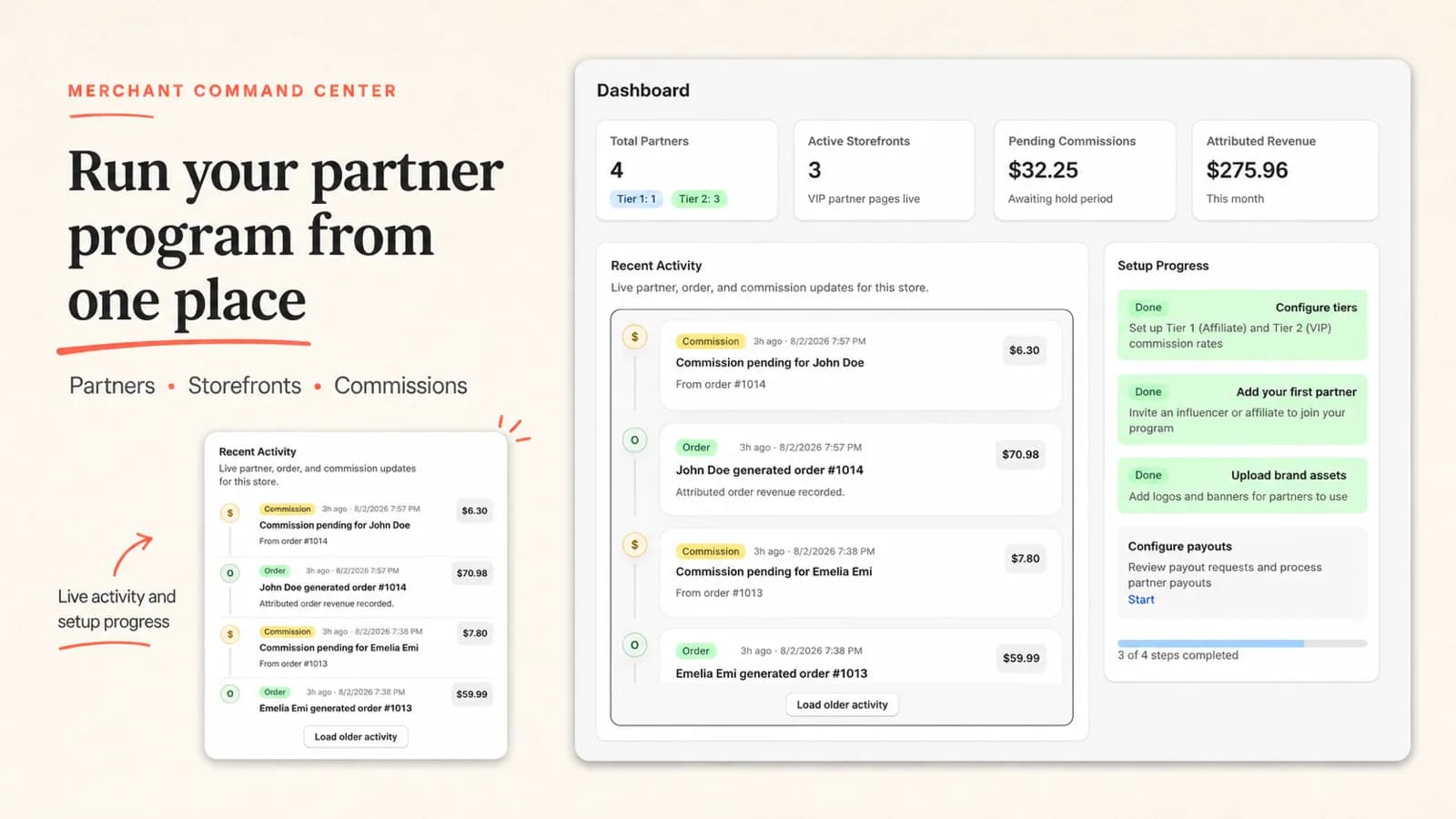
Affiliate programs rarely become difficult because generating a link is hard. The difficulty appears between the link and the payout: reviewing applications, keeping partner details current, explaining attribution, handling returns, checking commissions, and knowing what is actually ready to pay. A clear operating model turns those scattered tasks into a program merchants and partners can trust.
Create one operating flow
Connect partner intake, links, orders, commissions, and payouts instead of rebuilding context across separate sheets.
Make decisions explainable
Document attribution and commission rules so merchants and partners understand how an order becomes earnings.
Scale with control
Use consistent review stages and ownership before adding more partners, offers, or storefront experiences.
Start with the operating model, not the partner count
A large list of applicants is not a functioning affiliate program. Before inviting more people, define the path each partner follows: application or invitation, review, approval, access, promotion, attribution, commission clearance, and payout. Give every stage an owner and a visible status.
This makes the program easier to run and easier to join. Merchants know which action is next, while partners are less likely to wonder whether an application, order, or payout request has disappeared into a spreadsheet.
- Decide what information is required before approving a partner.
- Define who reviews applications and how often that queue is checked.
- Document when access, links, and storefront tools become available.
- Set a repeatable cadence for commission and payout review.
Onboard partners with enough context to succeed
Approval is only the beginning. A useful onboarding experience explains what the brand expects, which products or offers are available, where tracked links come from, how performance is measured, and when earnings become payable. Keep the first steps short enough to complete in one session.
Different partners may need different levels of access. A new affiliate may begin with tracked product links, while an established partner may need a curated storefront, campaign assets, or a specific commission arrangement. The workflow should support those differences without making the basic path confusing.
Make attribution rules understandable before traffic arrives
Attribution becomes a support problem when the rules are invisible. Merchants should be able to explain what identifies a referral, how long attribution remains valid, what happens when more than one partner influences an order, and which order events affect commission eligibility.
Review those rules against real customer journeys rather than idealized ones. Test a referral that converts immediately, one that returns later, an order that is partially refunded, and a purchase containing products with different commission treatment. Clear edge cases prevent unclear earnings later.
Treat commissions as a lifecycle, not a single number
An attributed order does not always equal a payable commission. Orders can be cancelled, returned, refunded, or held until a defined clearance period ends. A dependable program preserves the connection between the order, the applied rule, the calculated commission, its current status, and the eventual payout record.
Use distinct states such as pending, cleared, held, and paid. Partners should see enough information to understand their earnings, while merchants need a review queue that highlights exceptions instead of forcing them to recalculate every order manually.
Use one weekly rhythm to keep the program healthy
A lightweight operating rhythm is more valuable than an elaborate dashboard nobody reviews. Check new applications, unusual attribution activity, commissions approaching clearance, payout readiness, and partners who may need support. Record decisions where the underlying partner and order context already lives.
Affilyn brings partner applications, branded storefronts, attributed links and orders, commission activity, content-rights workflows, and payout organization into one Shopify-focused product. The goal is not to remove judgment from affiliate operations; it is to give each decision the context it needs.